There is a distinct line running through my artistic practice that has evolved independently of political processes, social conflicts, and the constant noise of current affairs. It is a body of work in which the central role is always played by the human being—their relationships, memory, traditions, emotions, and their natural coexistence with the surrounding world. Although each project has its own subject matter and visual language, they are all united by a desire to reveal what exists quietly and persistently beneath the surface of everyday life.
Over time, I realized that these works gradually approached the fields of visual anthropology and ethnology. Not because they aim to produce scientific knowledge, but because they explore people within their natural cultural environment—through traditions, everyday rituals, family relationships, professional communities, and the ways cultural memory is transmitted from one generation to another. My interest lies not in grand historical narratives but in the small human stories that silently shape society. It is within these stories that I find universal values that endure regardless of political circumstances or historical change.
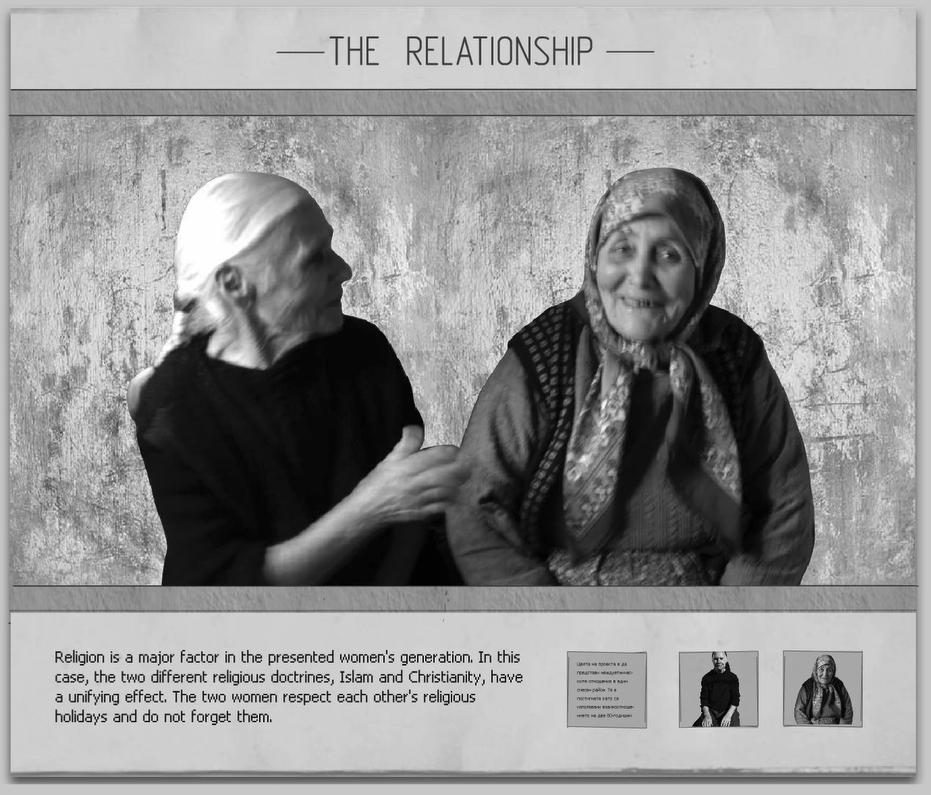
Everything began with the project Three. In it, I photographed my grandmother Elena together with our Turkish neighbor, Grandma Hayriye, from my hometown of Kardzhali. The two women did not share a common language. My grandmother spoke no Turkish, while Hayriye understood no Bulgarian. Yet this was never an obstacle to their relationship. They respected each other's traditions and religious holidays, exchanged food and gifts, helped one another, and maintained a genuine sense of neighborliness that required neither mediation nor political explanation.
To complement this story, I added two more. One centered on a healing spring in the region, visited by both Bulgarians and Turks who are united by a shared belief in its curative power. The other portrayed a small town near Kardzhali where the local Turkish community collected donations to repair the roof of the Orthodox church. Together, these three narratives formed a story about coexistence founded not on declarations or ideology, but on simple everyday acts of humanity. From an ethnological perspective, they reveal shared cultural practices and collective local memory, demonstrating how traditions can serve as bridges between people rather than boundaries separating them.
I presented the project as a multimedia stop-motion animation composed of photographs, text, and music. It was my first attempt to combine technical knowledge with artistic expression. In many ways, the very structure of the work mirrored its content: just as separate images merged into a unified visual narrative, the different ethnic communities within the stories coexisted naturally, without the need for external political frameworks.
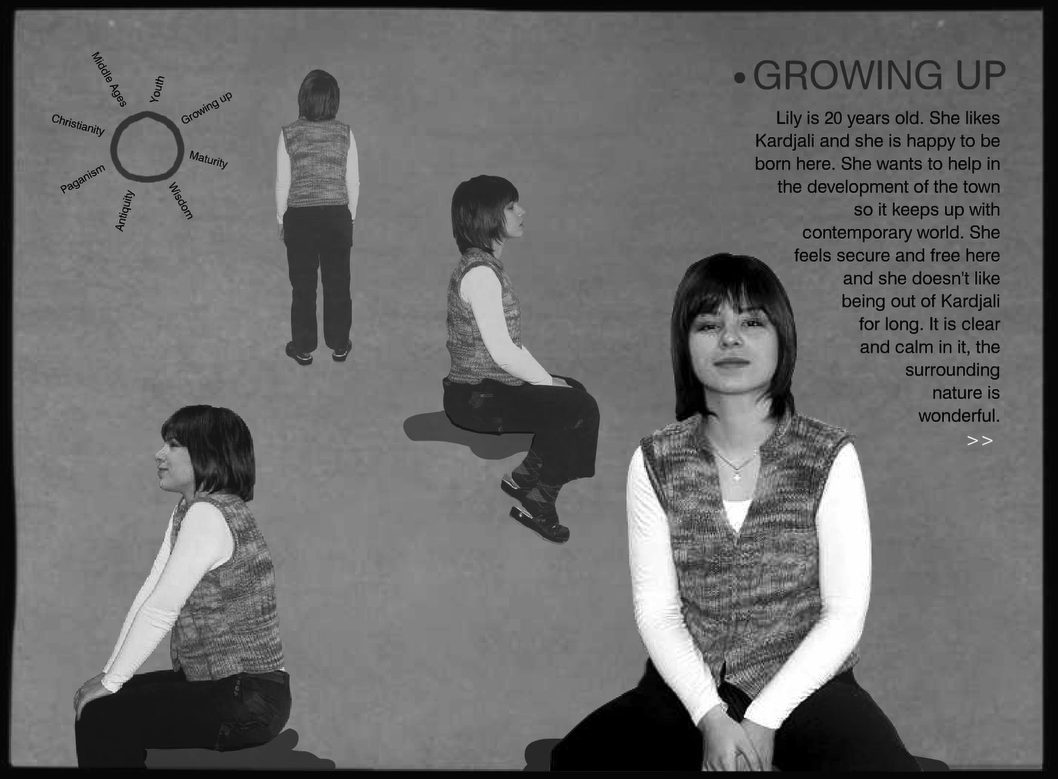
The next step was the project The Town. While Three explored relationships between people, this work examined the relationship between human life and historical time. I juxtaposed four of my friends, each belonging to a different generation, with four major stages in the development of the ancient town of Perperikon: its emergence, flourishing, maturity, and decline.
Like the life of a city, human life unfolds through successive stages. Family, work, friendship, and community remain constant values, yet their significance changes according to age, gender, and personal experience. History and the present began to reflect one another. The town ceased to function merely as an archaeological site and instead became a metaphor for human existence—an idea closely aligned with the anthropological understanding that culture and human beings continually shape one another.
Here again I employed the language of multimedia: text, photography, sound, and the slow movement of otherwise static images. This gentle motion became a metaphor for the passage of time. As I developed the project, I became increasingly aware of my own values. Family was no longer simply a subject within my work; it gradually became one of the foundations upon which I was building my own identity.
With the project Circle, my attention returned to human relationships. This time, I focused on a small team of three restorers. My interest was directed less toward the work they performed than toward the invisible dynamics that connected them. I sought to portray them almost exclusively through body language.
Like a carefully choreographed dance, their gestures, postures, and movements revealed the different roles within the group. Without a single spoken word, the viewer could distinguish the leader, the craftsman, and the creator, while also sensing the subtle interactions between them. Sound served only to reinforce this almost entirely nonverbal narrative. In essence, the project became an exploration of communication beyond language—an area of shared interest for both anthropology and psychology.
At the heart of my artistic research lies the question of the relationship between language and image, between thought and its visual and sonic manifestations. For years, I have explored how thought emerges, how it takes shape somewhere within the cerebral cortex, much like a process of internal secretion—an invisible yet active force that gradually transforms itself into image, symbol, and action.
This exploration has found expression in a series of digital works structured along an imaginary line—from Malevich through Kandinsky to Matisse.
The first work begins with the idea of the Black Square—not so much as an ultimate form, but as a question about what lies beyond it. I used the sounds of bells, each sound generating a brief animation of a pulsating colored circle. The circle emerges, expands, and slowly fades away together with the resonance of the bell.
More than thirty sounds, mapped onto the keys of a computer keyboard, allow the creation of simple compositions of sound and color. To me, this is a metaphor for the birth of thought—the colors are the connections between neural impulses, and their combination into melody creates the perception of a complete phenomenon, naturally leading us to the next stage.
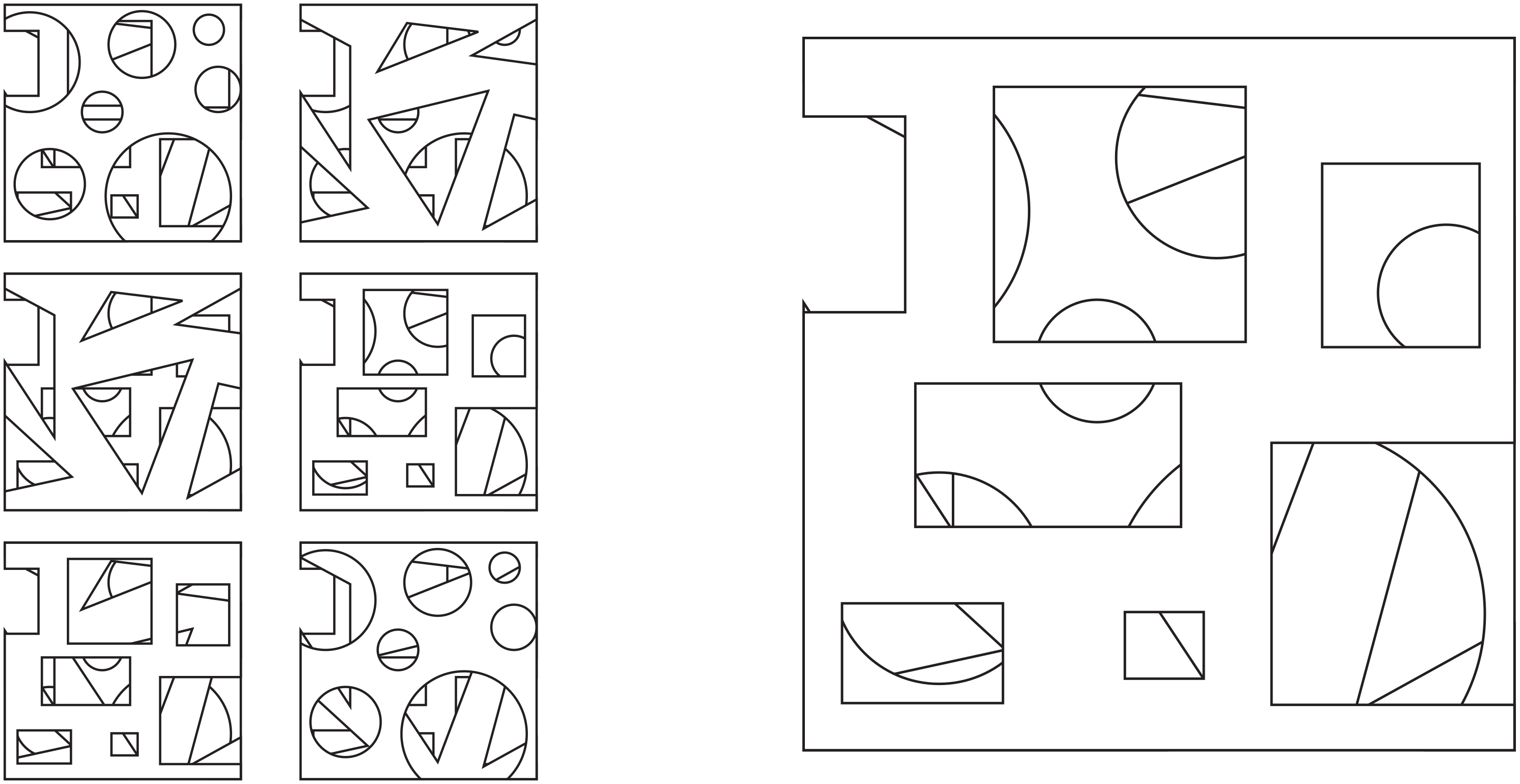
The second work explores the way thought becomes abstraction. Within a square I cut triangles, circles, and squares, organizing them into three separate layers. Their overlapping generates an abstract composition in constant transformation.
By interactively rearranging the layers—placing the squares in front, then the triangles, then the circles—new visual relationships emerge. The same happens with color. The three primary colors—yellow, red, and blue—alter the perception of the composition without changing its structure.
To this I add sound composed of three elements: piano, human voice, and the sound of the sea. Thus, different modes of perception arise, different combinations and permutations of the same thought. This is the space in which abstraction exists as possibility.
When abstract thought becomes too complex, the time of the symbol arrives.
A symbol contains far more information within itself, much like an archetype. In the third work I focus on six colors, constructing around them a system of personal associations.
The symbols appear as a dance of thoughts—they emerge from a human head, move to the rhythm of specially composed music, forming a thread of meanings, and at the end of the melody they return to consciousness, now ordered and harmonized.
What is fascinating here is that the viewer may choose the sequence of colors and thus create different combinations of symbols and meanings. Green, red, and blue tell one story; yellow, orange, blue, and red tell another.
Gradually, a complete visual narrative takes shape, in which symbols dance like the figures of Matisse—free, rhythmic, and inseparably connected.